Go to US Store
Recessed and Countertop Outlets: A Complete Buyer's Guide

Let's be honest: standard outlets can be an eyesore. In a kitchen, or anywhere you have spent real money on stone backsplashes and finishing touches, that bulky receptacle becomes the small thing that quietly bugs you every time you walk past it. Recessed and countertop outlets fix that. This guide covers what they are, how the main types differ, and how to choose the right one for your space.
What is a recessed outlet?
A recessed outlet is an electrical outlet that sits flush (or close to flush) with the surface it is mounted on, rather than protruding as a standard receptacle does. The result is power exactly where you need it, without an outlet interrupting the look.
Docking Drawer has been solving modern power problems since 2014, when we introduced the first in-drawer outlet and, in doing so, helped create the category of built-in, discreet, convenient outlet alternatives. The same idea now spans several formats, from outlets recessed into a wall to outlets set flush into a countertop.
The main types, compared
Most low-profile outlets fall into three categories. Each installs differently and suits different installation locations, so seeing the options side by side can help you narrow your choices quickly.
| Type | How it installs | Best for | Visibility | Moving parts |
|---|---|---|---|---|
| Recessed wall outlets (Shop Recessed Outlets) | Set into a wall or backsplash, can be flush or surface-mounted | Backsplashes and walls where a standard outlet looks bulky | Low profile, always open and available | None |
| Recessed countertop outlets (Shop Countertop Outlets) | Installed into a cutout in the counter, can be flush or surface-mounted | Easily accessible power in kitchen islands and peninsulas with limited under-counter clearance | Sits flush with counter or on surface with a lid (depending on installation method) | None for flush installations; a cover flips open to reveal outlet for surface-mount installs |
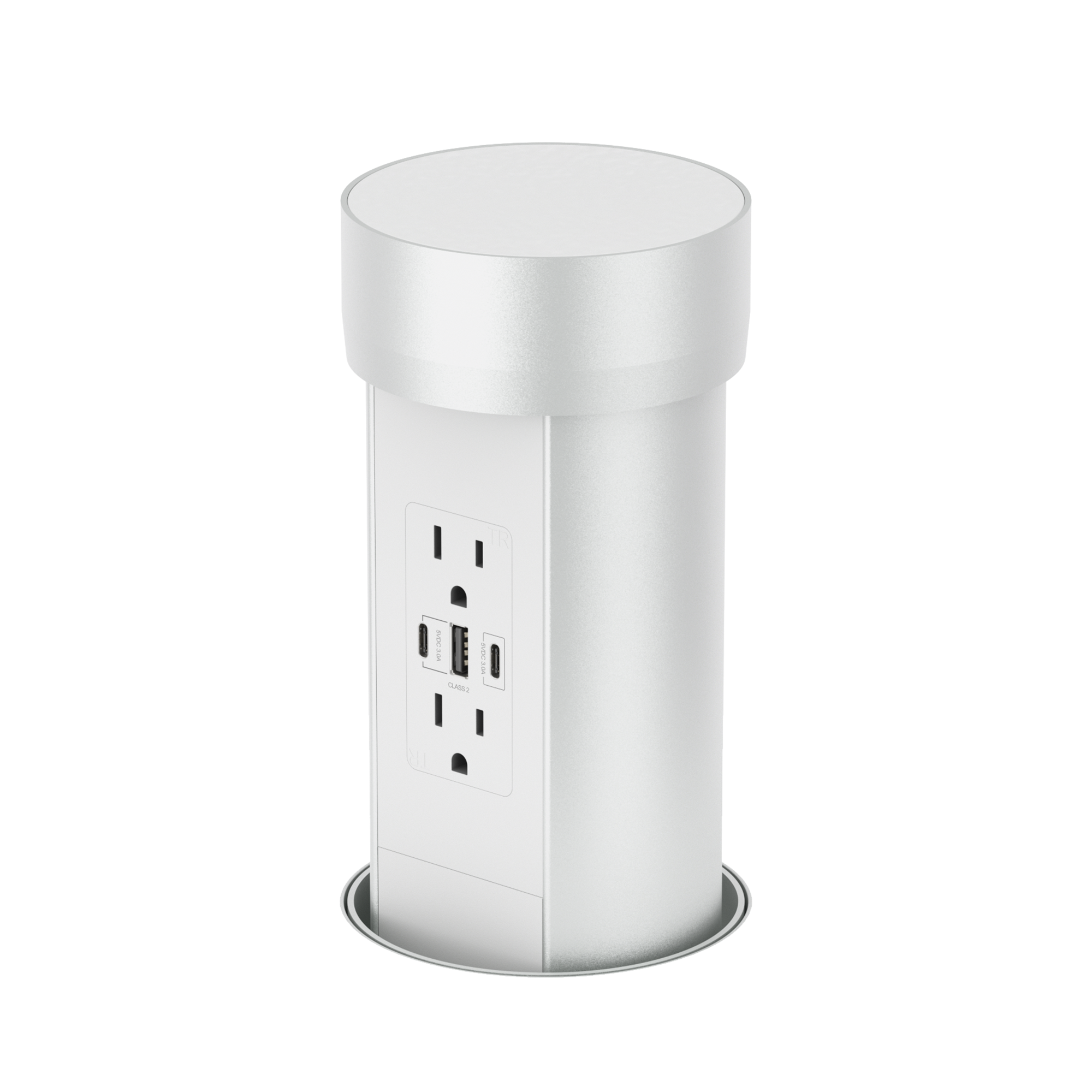
| Pop-up outlets (Shop Pop-Up Outlets) | Installed into a counter cutout, rises when needed and retracts when not | Easily accessible power in kitchen islands and peninsulas that have sufficient under-counter clearance | Hidden when retracted, sits above counter when expanded | Motorized lift |
For many kitchens, the two formats worth the closest look are recessed wall outlets and recessed countertop outlets. They give you always-ready power, with the simplest installation and no moving parts. Pop-ups earn their place when you want more connection points, when you have ample under-counter clearance, and/or when hiding the outlet completely (when not in use) is most important. We will cover all three in this article.
Recessed wall outlets
Our recessed wall outlets install into the wall or backsplash, flush or surface-mounted to suit the look you're after. A flush mount sits the outlet in line with the surface so it sits back and stays subtle, while a surface mount sits just proud of the wall for a slightly different finish. Either way, this is the format to reach for when you want power on a backsplash, a feature wall, or anywhere a raised outlet and cover plate would interrupt the material and the look you paid for.

Sitting close to the wall has a practical payoff, too. A recessed outlet plays nicely with small appliances pushed tight against the wall, where a standard receptacle and plug would force an awkward gap. And behind a range or along a counter, it keeps the tile or slab as the star, not the hardware.
Docking Drawer's recessed wall options include the Prado Discreet Outlet line, built for backsplash and wall installs where you want power to nearly disappear. You can see the full range on our recessed outlets page.
Recessed countertop outlets
A countertop outlet puts power directly on the work surface, which is where you actually use it: charging a phone on the island, running a mixer, plugging in a laptop at the counter. There are two options to consider, and the right one depends on how many things you need to plug in and how much room you have under the counter.
Option 1: Legrand Countertop Outlets by Docking Drawer
The first option installs into a cutout in the counter and can be set two ways:
- Flush-mounted: the outlet is recessed to sit level with the surface, with no hardware showing when it is not in use. The outlet stays open and facing up, always ready.
- Surface-mounted: the outlet body sits at surface level under a metal lid, available in finishes like black, white, stainless steel, and brushed champagne bronze. Flip the lid up to reveal the outlet.

Either way, there is nothing to raise or lower, so power is always ready, and the low profile keeps the island looking finished. These are also the first upward-facing countertop outlets to pass the rigorous UL 498 half-gallon spill test, which matters when the outlet lives on a surface where drinks get knocked over, and counters get wiped down. Built with a slim profile that sits cleanly in the counter, this is an excellent choice for a kitchen island outlet. See our full lineup of options on our countertop outlets page.
Option 2: Pop-up outlets
The second option is the one to reach for when you want more connection points and you have more under-counter space to accommodate a larger receptacle when it is depressed. Because a pop-up houses a lift mechanism, it typically offers more outlets and a wider mix of connection points, and it retracts completely flush, so the hardware disappears when you are done. The trade-off is space: a pop-up needs sufficient clearance under the counter for installation, so it suits islands and cabinets with room to spare. If you have the depth and you want the most ports, the most variety, or an outlet that vanishes entirely between uses, see our lineup of pop-up outlet solutions.

Which one is right for you?
The best fit comes down to four questions:
- How much space do you have under the counter? A pop-up needs meaningful clearance beneath the surface to house its mechanism, so it suits islands and cabinets with room to spare. If under-counter space is tight, the Legrand's slim profile is the more practical fit.
- How many things do you need to plug in at once? If it is usually one, a Legrand Countertop Outlet covers it cleanly. If you regularly run several at a time, a pop-up gives you more outlets in a single install.
- Do you want fast-charging USB-C ports? Pop-ups typically offer a wider mix of connection points, including fast-charging USB-C, so if charging phones, tablets, and laptops at speed matters, that is the one to look at.
- Do you want the outlet to disappear completely? This is where a flush-mounted pop-up stands apart. Because it retracts and is capped with a piece of your own countertop, it truly vanishes when it is down, leaving an unbroken surface. A flush Legrand outlet sits level with the counter, but its opening stays visible at the surface. Both look clean; only the pop-up disappears entirely.
In short: for simple, always-ready power with a simple install, reach for the Legrand Countertop Outlet. For more connection points, fast-charging USB-C, and an outlet that disappears into the countertop, go with a pop-up (assuming you have the under-counter clearance to accommodate it).
How to choose a recessed outlet for your kitchen
Start with one question: where does the power need to be?
- A backsplash, feature wall, or any area where power meets a vertical surface points you toward a recessed wall outlet.
- A kitchen island or peninsula surface points you toward a countertop outlet, where you then choose between a Legrand Countertop Outlet and a pop-up (see above for that breakdown).
Placement, height, and code considerations
A few questions come up for almost every countertop project, so here is the practical version. Local electrical code always governs, and a licensed electrician should confirm anything specific to your home, but this is the general shape of it.
How high should kitchen outlets be above a countertop? Wall outlets serving a counter are commonly installed a few inches above the backsplash or counter surface. The bigger rule to know is spacing: electrical code is written so that no point along a counter is very far from a receptacle, which is why kitchens end up with outlets spread along the backsplash rather than clustered in one spot. Your electrician will place them to meet the spacing your local code requires.
Do countertop outlets need to be GFCI? For kitchen countertop receptacles, GFCI protection is generally required by the National Electrical Code because the outlets are near water and heavy appliance use. Treat GFCI protection as a requirement for any kitchen counter or island outlet, and confirm the specifics with your electrician.
Can an outlet be installed facing up in a counter? This is the detail that matters most for countertop power. The National Electrical Code in the US has long restricted the installation of receptacles face-up in a work surface unless the product is specifically listed for that use, which is exactly why purpose-built countertop and pop-up outlets exist. They are designed and listed for installation in a counter, where a standard receptacle turned face-up would not be. It is the main reason to use a product made for the job rather than improvising.
Installing a recessed outlet
At a high level, installing a recessed or countertop outlet means cutting an opening sized to the product, running or extending the circuit to reach it, and mounting the outlet so it sits flush with the surface (for flush-mount installs only). Countertop installs also involve a clean cutout in the counter material, which is best planned before the counter is fabricated, when possible.

Electrical work carries real safety and code implications, so recessed and countertop outlets should be installed by a licensed electrician, and any cutout in stone or solid surface should be made by a qualified fabricator or installer. If you want the step-by-step, see our dedicated installation guide, and always follow the instructions that ship with your specific product.